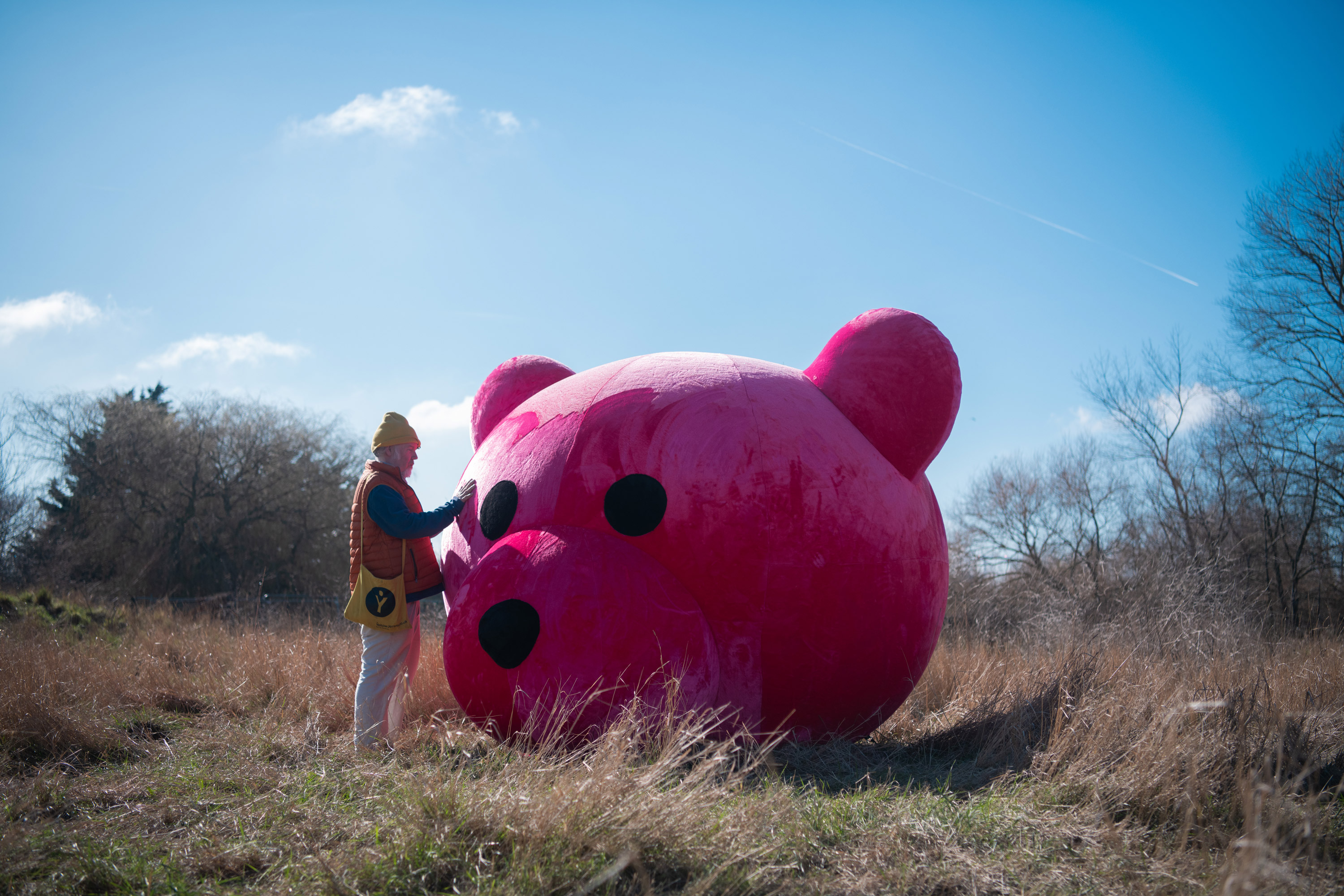
Seeds of Change brought together public Sculpture, ecological processes and community participation through a project supported by Arts Council England. Presented at Winter Sculpture Park IV in Thamesmead, London, LUAP installed Soft & Fragile, a three-metre inflatable head of The Pink Bear, alongside dozens of small, hand-cast Seed Heads across the rewilded landscape of a former golf course. The two sculptural elements explored contrasting relationships between material, scale and permanence.
While the inflatable maintained its form through air and fabric, the smaller Sculptures were conceived to deteriorate and contribute to the surrounding environment. The project extended beyond the exhibition through public participation and six creative workshops with Mind in Bexley. Connecting the physical processes of nature with experiences of personal change, Seeds of Change considered how fragility and transformation can be understood through both material and creative practice.
The former Thamesmead Golf Course provided a distinctive setting for the project. Closed to the public for more than a decade, the land had been undergoing natural rewilding, with vegetation gradually reclaiming areas previously maintained for recreation. Rather than treating the landscape as a neutral backdrop, LUAP developed work that would respond to its changing conditions. The site became an active part of the exhibition, allowing the relationship between the Sculptures and their environment to evolve beyond their initial installation.
At the centre of the landscape stood Soft & Fragile. Measuring three metres high, the inflatable Sculpture developed the enlarged head of The Pink Bear into a temporary, lightweight form. Following the monumental recycled-plastic Pavilion created in Hamburg in 2024, LUAP approached the same recognisable image through an entirely different material. Where the Pavilion relied on an engineered structure, Soft & Fragile depended on air and fabric to maintain its volume. Its physical presence contrasted with the vulnerability of its construction, allowing the material itself to express the uncertainty of permanence.
The smaller Sculptures, collectively titled Seeds of Change, introduced a different relationship between artwork and environment. Incorporating wildflower seeds selected with local ecological knowledge, the works were intended to contribute to the rewilding process already taking place at Thamesmead. Their connection to the landscape extended beyond the period of exhibition, with the possibility of supporting bees and other pollinators through subsequent growth. The ecological function of the material became inseparable from the artistic intention.
For LUAP, this relationship between the temporary object and the possibility of new life reflects experiences of psychological change. As he explained, "Sometimes things need to fall apart before they come together." Rather than approaching fragility solely as a condition of damage or loss, the project considers how periods of uncertainty can create opportunities for development. These ideas emerge through the physical behaviour of the Sculptures, allowing the processes of change and renewal to become part of the work itself.
Alongside the outdoor exhibition, LUAP worked with Mind in Bexley to deliver six creative workshops for community groups, including those supporting people experiencing depression, anxiety and symptoms associated with menopause. Drawing on his own experiences of mental health and the role of creativity in his practice, LUAP encouraged participants to explore images, colours and memories of personal significance. These became starting points for Painting and drawing, with professional art materials supplied by Daler-Rowney. The sessions welcomed different levels of artistic experience, allowing participants to develop their own approaches without expectations of a particular result.
The workshops extended the project's concerns into individual creative experience. For some participants, making art offered an opportunity to reconnect with activities they had not practised for many years. Others explored personal experiences through images rather than words. The emphasis was on the process of making rather than the production of a predetermined artwork, providing space for experimentation and reflection. In this context, creativity became a means of exploring change through direct personal experience.