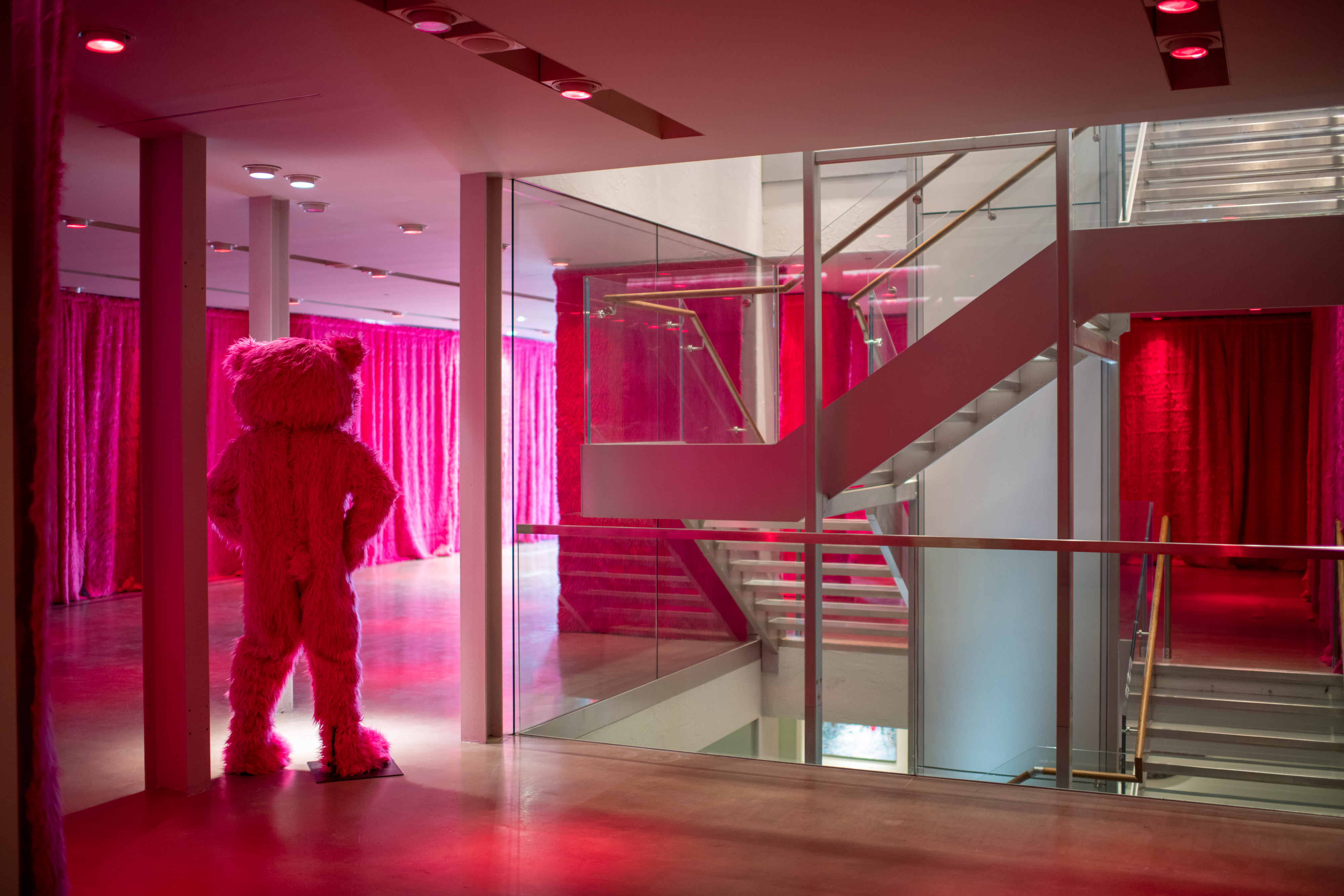
The Unconscious Therapy transformed three floors of a 6,000 sq ft building on New Bond Street into an exploration of mental health, memory and the restorative qualities of everyday experience. Curated by MC Llamas and presented in partnership with Great Portland Estates during Frieze Week 2021, the exhibition brought together LUAP's Painting, Photography, Sculpture and Installation. Developed through three years of artistic research, the work examined how activities undertaken instinctively can become essential to psychological wellbeing.
At the centre of the exhibition was an immersive room enveloped in more than 150 metres of pink fur, extending The Pink Bear from a recurring figure into a physical environment. Elsewhere, large-scale Paintings, Photography and sculptural works explored the relationship between natural landscapes and internal experience. Presented following successive periods of pandemic lockdown and social isolation, the exhibition considered the importance of recognising the often overlooked experiences that provide comfort, reflection and connection.
The Unconscious Therapy emerged from LUAP's recognition that experiences central to his life and artistic practice had long provided psychological support without being consciously understood as therapeutic. Travelling, walking through unfamiliar landscapes and making photographs initially offered opportunities for escape and reflection. Over time, these activities became deliberate parts of his creative process. The exhibition extended this understanding to everyday experiences, considering how seemingly ordinary moments can influence emotional wellbeing without the intention or structure of formal therapy.
The exhibition brought together work developed through journeys across New Zealand, Indonesia, Scotland and England. Physical travel and immersion in the landscape are integral to LUAP's approach, with Photography produced on location before selected images are developed into large-scale Paintings by hand. The movement between direct observation and painted interpretation allows the artist to explore how experiences are altered through memory and perception. Landscapes become more than recorded locations, carrying associations formed through the circumstances of their creation.
Within the Paintings, natural forms provide a visual language for experiences that can be difficult to articulate directly. Forests suggest the complexity of thought and memory, while flowers introduce questions of time, attachment and impermanence. In works such as Love Life, colour and abundance coexist with an awareness of life's fragility. The apparent optimism of the imagery is therefore complicated by the recognition that beauty and loss are inseparable, reflecting LUAP's interest in how opposing emotional states can exist simultaneously.
The exhibition extended these concerns into physical space. Its most distinctive Installation transformed an entire room through the use of more than 150 metres of pink fur, the material associated with LUAP's recurring Pink Bear. Developed with curator MC Llamas, the work altered the conventional distance between artwork and viewer. Rather than encountering the character within an image, visitors were surrounded by its material presence. The familiar softness of the bear became an architectural environment, introducing a relationship between comfort, enclosure and sensory intensity.
The physical experience of the Installation was deliberately contradictory. Its pink surface suggested warmth, innocence and reassurance, while the scale and repetition of the material created an unfamiliar, almost disorientating space. This tension reflects the dual nature of The Pink Bear throughout LUAP's practice. Originating through his experience of cognitive behavioural therapy, the character developed into a means of exploring mental health and identity without requiring these experiences to be represented literally. Within the Installation, its protective qualities became something that could be encountered through the body rather than observed from a distance.
Across the remaining gallery spaces, Painting, Photography and Sculpture offered different approaches to the same enquiry. The movement between individual images, sculptural figures and an immersive environment shifted the relationship between observation and participation. Works rooted in actual landscapes were brought into dialogue with the artificial world of The Pink Bear, allowing visitors to encounter the contrast between lived experience and its psychological interpretation.
The exhibition's presentation in October 2021 gave these ideas a particular urgency. Successive lockdowns during the COVID-19 pandemic had disrupted ordinary routines, limited social contact and altered people's relationships with their immediate surroundings. Activities that might previously have passed unnoticed, from spending time outdoors to finding moments of solitude or connection, had acquired renewed significance. Against this background, The Unconscious Therapy considered the value of recognising the small experiences through which people sustain their emotional lives, without presenting a universal solution to psychological distress.
By bringing together the personal origins of The Pink Bear, the physical experience of nature and the possibilities of immersive Installation, The Unconscious Therapy examined how external environments can influence internal experience. The exhibition moved between the observed world and the spaces constructed through memory and imagination, allowing ideas developed through individual artworks to be encountered on an architectural scale. At its centre was a consideration of the ways people find reassurance and meaning through experiences whose importance is not always immediately apparent.