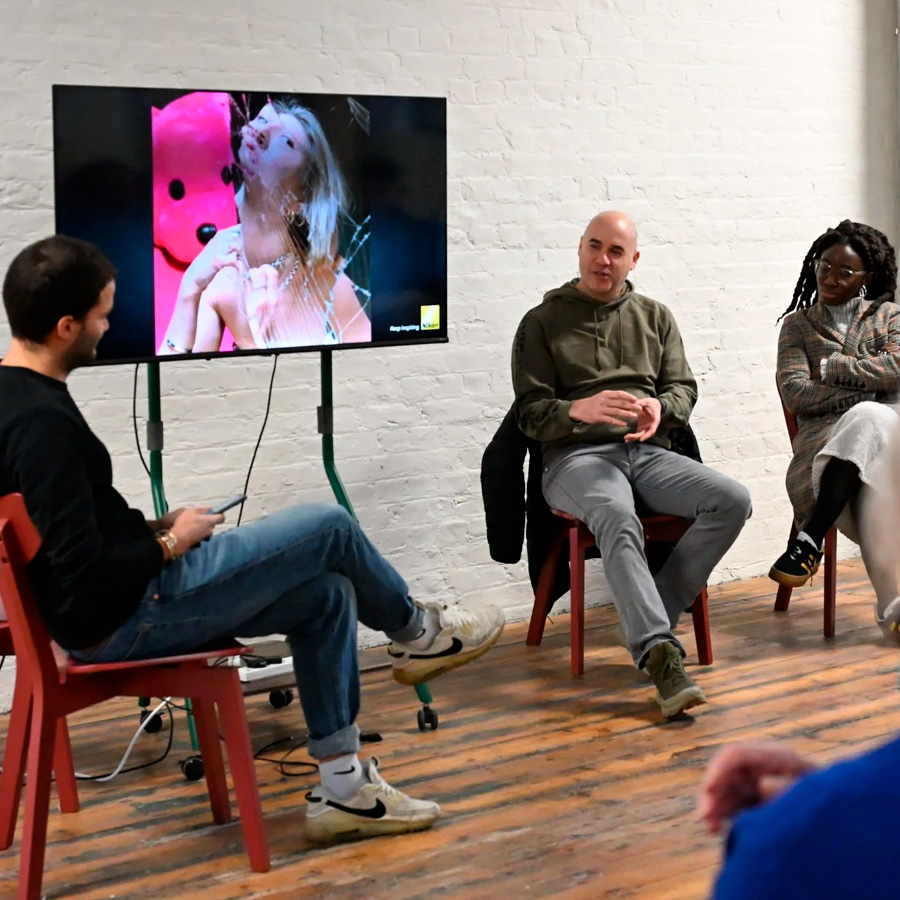
Royal Academy of Arts Patrons recently visited LUAP’s East London studio to see Photography, Paintings and works in progress developed from journeys through Mongolia and South America.
The visit focused on bodies of work that begin beyond the studio. LUAP shared Photography made on location alongside completed Paintings and canvases still in progress, allowing the conversation to move between the original experience, the photographic image and its later development through paint.
Mongolia and South America had a particular relevance to the Royal Academy’s programme at the time. Brasil! Brasil! The Birth of Modernism had recently opened at Burlington House, while the RA was developing a major exhibition on the art of the Mongol world for 2027.
Much of LUAP’s photographic work involves travelling with The Pink Bear into remote and physically demanding environments to produce the source images first-hand. The photographs are made in real locations without digital compositing. Carrying the costume and photographic equipment into these landscapes, and responding to the conditions encountered there, forms part of the process rather than simply providing a setting for the finished image.
In Mongolia, LUAP spent two weeks travelling on horseback after confronting a longstanding fear of horses. Learning to ride became inseparable from making the work, with The Pink Bear photographed on horse back throughout the journey. The resulting images became the foundation of My Little Pony, a body of Photography and Painting that continued to develop after his return to London.
Work made in South America opened a wider discussion around the role of travel, landscape and direct experience within LUAP’s practice. For LUAP, the photograph is not simply documentation of a journey made to produce the work. The journey is part of producing the image itself.
Back in the studio, these photographs become starting points for Painting. Patrons were able to move between source Photography, finished works and canvases at different stages of development, seeing how closely observed detail sits alongside changes in colour, surface and more expressive passages of paint.
The visit brought these different parts of LUAP’s practice together in one place, from the experiences and environments in which the photographs are made to the Paintings developing in the studio.